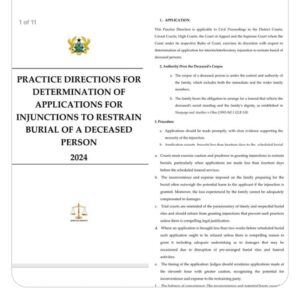
 A recent judicial decision in Ghana’s High Court has allowed a scheduled funeral to proceed after the plaintiffs failed to meet a monetary requirement introduced under the new Practice Directions for Determination of Applications for Injunctions to Restrain Burial of a Deceased Person (2024).
The directive, issued by the Judicial Service of Ghana, outlines stricter procedures for granting interim injunctions that halt funerals. According to the guidelines, applicants must provide clear evidence and, in certain cases, deposit a specified sum to secure an injunction.
In this case, the judge initially granted an injunction to stop the burial after requiring the plaintiffs to deposit GH₵2 million as security. The deposit was intended to cover potential damages or inconvenience caused to the deceased’s family if the injunction were later deemed unjustified.
However, the plaintiffs were unable to produce the required deposit within the stipulated timeframe. Recognizing the initial requirement as an error in applying the new directive, the judge revisited the decision and ruled that the funeral may proceed tomorrow, as the absence of the deposit nullified the injunction.
Legal experts say the new practice directions aim to balance the rights of applicants with the dignity of timely burials, emphasizing that courts should exercise caution when granting last-minute injunctions, especially within fourteen days of a scheduled funeral.
The decision has sparked discussion about the practical implications of the 2024 directive, with some stakeholders urging clearer guidelines on deposit amounts and timelines to avoid similar procedural delays in future cases.