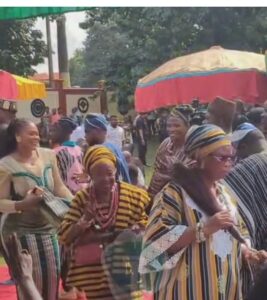
The drums spoke first. Then the horsetails swayed. And for a moment, Manhyia Palace was not just the seat of Asante power. It was a stage for Gonjaland.
The entourage of Yagbonwura Bii-Kunuto Jewu Soale I, Overlord of the Gonja Kingdom, performed the traditional Damba dance before Otumfuo Osei Tutu II this week, turning a historic royal visit into a masterclass in Ghana’s living heritage.
A Dance of Kings
Damba is not just dance. In Gonja, it is history in motion. Performed to mark the birth of the Prophet Mohammed and to celebrate chieftaincy, it blends rhythm, poetry, and martial display. The drummers praise lineage. The dancers, often princes and warriors, mimic battle and homage.
On Tuesday, under the gold-trimmed umbrellas of Manhyia, that tradition crossed the Black Volta.
Clad in rich smocks and talismans, the Yagbonwura’s drummers rolled out the lunga and dawule rhythms. Young men from Damongo spun and stamped, their boots kicking up dust as the crowd roared. Elders chanted appellations. And when the lead dancer knelt before Otumfuo with a white horsetail, the symbolism was clear: respect, unity, brotherhood.
Otumfuo, resplendent in kente, nodded and smiled. He later rose briefly, acknowledging the performance with his own gesture of honor – a rare moment of one King meeting another’s culture on his own soil.
More Than Ceremony
The visit itself is historic. While Asante and Gonja have traded and allied for centuries, a formal visit by the Yagbonwura to Manhyia is uncommon in modern times. Tuesday’s display was therefore both cultural and diplomatic.
“This is what we mean when we say Ghana has a deep culture,” said Nana Kwaku Amankwah, a cultural historian at KNUST who witnessed the event. “Damba in the heart of Asanteman tells our children that our traditions are not in competition. They are in conversation.”
The Gonja Kingdom, located in Savannah Region, is one of Ghana’s oldest centralized states. Its Damba festival, celebrated widely in Tamale, Yendi, and Damongo, is recognized by UNESCO as intangible cultural heritage. To bring it to Kumasi was deliberate.
“We came to greet our brother,” a senior Gonja elder from the entourage said. “The Yagbonwura says when two great trees stand together, the forest is stronger.”
The Politics of Culture
In an era where chieftaincy disputes and land litigation dominate headlines, the Manhyia performance cut a different image. Here were two of Ghana’s most powerful traditional rulers using dance, not decrees, to affirm ties.
Otumfuo has championed inter-ethnic unity, hosting the Okyehene, the Ga- mantse, the Yaa Naa, and now the Yagbonwura. For the Yagbonwura, who ascended the Jakpa Skin in 2023, the visit cements his role as a unifier in northern Ghana.
The crowd felt it. Market women paused their trading. Tourists put down phones and simply watched. Children perched on walls to see the smocks and the spin.
Why Damba Matters in 2026
Ghana’s chieftaincy institutions face pressure to stay relevant. Some youth see them as relics. But events like this make the case for culture as soft power.
Damba teaches genealogy without a textbook. It teaches diplomacy without a summit. And it teaches that the stool, the skin, and the throne can still gather people when politicians cannot.
As the drummers receded and the Yagbonwura’s delegation took their seats, Otumfuo’s linguist gave the final word: “Today, Gonja has danced. Asante has seen. Ghana has won.”
In a country often divided by party colors, the horsetail and the Golden Stool found common ground. And for a few minutes in Kumasi, Ghana remembered that its strength is not just in gold or cocoa. It is in the drum.
The historic visit continues with closed-door discussions between the two palaces. The Yagbonwura’s entourage is expected to tour the Manhyia Palace Museum before departing for Damongo on Thursday. Alexander Afriyie, supervising editor, ghanacrimereport.com and ghanatalk.com