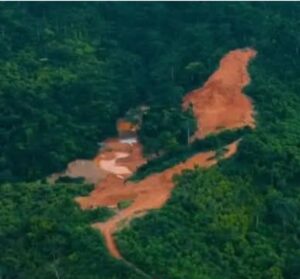


Illegal mining, known locally as galamsey, has gained a dangerous foothold in the Lake Bosomtwe enclave, with fresh scars now visible along the hills stretching from *Beposo to Nkwatapon, including the slopes of Ankaase Hill.
Aerial images from the area show active excavator operations, muddy pits, and heavily disturbed earth within forested zones. The sites sit close to human settlements, with buildings and roads visible at the edge of the destruction. While the operations have not yet reached the shoreline of Lake Bosomtwe itself, environmental activists and residents warn that tributaries feeding the lake are already gone.
A Crisis in Plain Sight
What has shocked observers is the location. The Beposo–Ankaase–Nkwatapon stretch is not remote. It is a corridor routinely used by the Member of Parliament for the area, the Bosomtwe District Chief Executive, the District Police Commander, the Ashanti Regional Minister, and local chiefs.
“People live here. Officials pass here almost every day. So why is this galamsey challenge only coming to light now?” a resident of Beposo asked. “We are shocked we are only hearing or seeing it at this stage.”
Locals say mining in this particular spot started about 7 years ago but has intensified in the last 24 months. The area is now “speedily becoming notorious” for galamsey, with heavy machinery moving in and pits expanding weekly.
Farmers Selling Out
A key driver is the willing sale of farmland. Multiple farmers in the enclave have confirmed that they are selling cocoa and food crop farms to miners for immediate cash.
“Hunger is now. Cocoa is later,” one farmer at Ankaase explained. “The miners come with money. The land is no longer yielding like before, and the young men don’t want to farm. So we sell.”
District agric officers say the trend threatens food security and the long-term viability of tree crops in Bosomtwe, one of the few cocoa-producing districts left in Ashanti.
Not in the Lake, But the Damage Is Done
The good news, residents say, is that the excavators are “on the hills and not directly near Bosomtwe. ”The bad news: “The surrounding rivers are gone already, especially from Beposo ascending the Ankaase hill.”
Lake Bosomtwe, Ghana’s only natural lake and a UNESCO Biosphere Reserve, depends on small streams and underground seepage from these surrounding hills. Hydrologists warn that destruction of the hillsides causes siltation, alters drainage, and cuts off feeder streams.
“Once the hills go, the lake goes next,” said a KNUST environmental scientist who inspected the images. “The turbidity we see in those pits is exactly what we don’t want in Lake Bosomtwe. This is how Pra and Ankobra died.”
Questions for Authorities
The revelations raise difficult questions:
1. How did excavators get here? The route to Ankaase Hill passes through Beposo, a busy town. Moving heavy equipment requires fuel tankers, lowbeds, and security.
2. Where are the regulators? Minerals Commission, EPA, and the district security council are all mandated to police such activity.
3. What is the role of local chiefs? Under Ghana’s laws, no mining can happen without traditional authority involvement. Yet the land is being sold and dug.
4. Why the silence? With the MP, DCE, Police Commander and Regional Minister all using the route, residents are asking who knew what, and when.
Officials Respond
Contacted, the Bosomtwe District Assembly said it was “aware of pockets of illegal mining” and that a DISEC meeting has been called. The Ashanti Regional Coordinating Council said a team would visit the site “within the week” for assessment.
What’s at Stake
Lake Bosomtwe is not just water. It supports over 30 communities, fish stocks, tourism, and spiritual heritage for the Ashanti people. It is a closed lake with no outflow. Whatever enters, stays.
If the hills from Beposo to Nkwatapon become a mining zone, experts say the lake faces the same fate as water bodies in Amansie West and Central – discoloration, dead fish, and lost livelihoods.
The Way Forward
1. Immediate stop: Security agencies must halt active operations and seize equipment, as seen in the images.
2. Audit the route: Who authorized fuel, movement of excavators, and the sale of farms?
3. Alternative livelihoods: Farmers are selling because cocoa prices and food inflation have squeezed them. COCOBOD and the District Assembly must intervene.
4. Community monitoring: The same chiefs, MP, and DCE who use the road must empower local watchdog committees with hotlines to the Minerals Commission.
5. Restore: EPA must begin reclamation talks now. Every month of delay makes recovery costlier.
For now, the excavators are still on the hills. But the clock is ticking for Lake Bosomtwe.
Have information on galamsey in the Bosomtwe enclave? Contact the Minerals Commission toll-free line or the Ashanti Regional Police Command.
Alexander Afriyie, supervising Editor, Ghanacrimereport.com and Ghanatalk.com